Run Control
Runs are limited to the two published research examples. Each result identifies whether it was generated now or captured earlier.
00 / Transparent Research Build
Google Summer of Code 2025 / P4 Language Consortium
Scaling stateful decision-tree inference in P4 — built as a GSoC 2025 project and shipped as inspectable evidence.Runs are limited to the two published research examples. Each result identifies whether it was generated now or captured earlier.
Loading available sources...
01 / Packet Journey
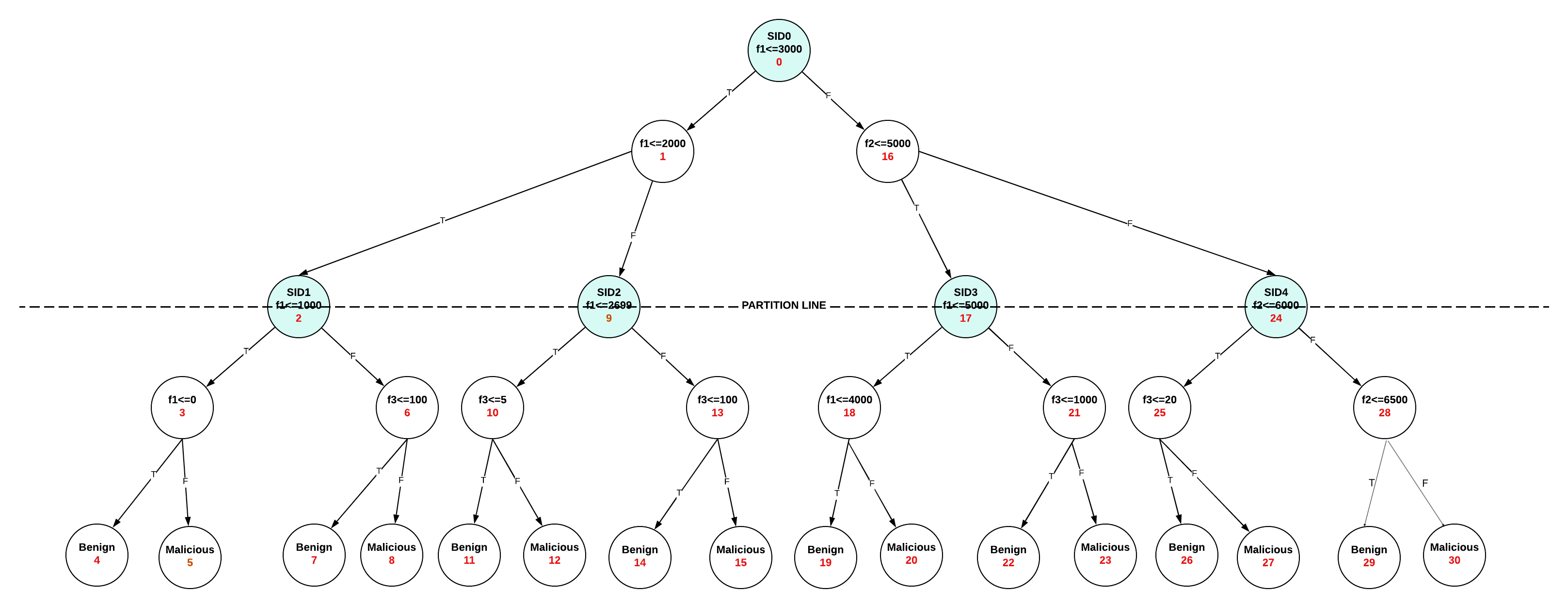
Watch ten packets form two feature windows. At each window boundary, the active subtree evaluates real if/else thresholds, converts the leaf class into the next SID, and either persists that state or emits the final digest.
02 / Execution Trace
Select a model and source above. The resulting stages, commands, inputs, outputs, and logs will appear here.
03 / Proof Files
Model files, mappings, P4 output, target state, timings, and checksums will appear here.
04 / Research Record

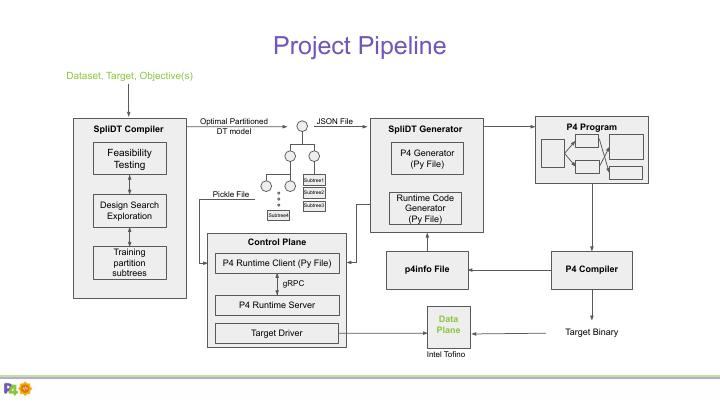
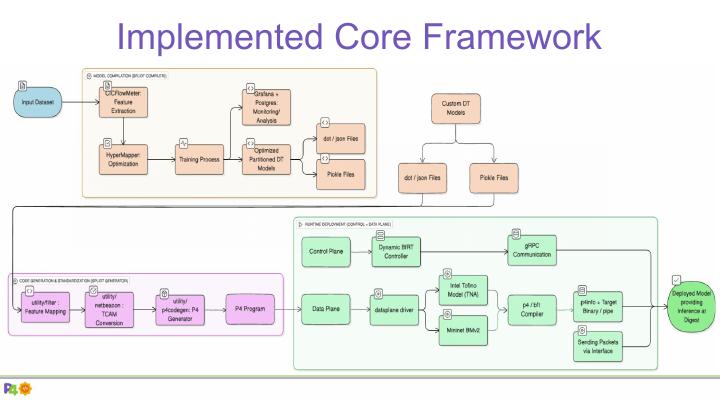
The public showcase connects the original partitioned-tree idea to generated P4, control-plane rules, packet state, and verifiable target evidence.
05 / Systems In The Loop
P4 grew from the programmable-networking research community around Stanford and its collaborators. Today it is a global open-source project hosted by the Linux Foundation; SpliDT applies that lineage to stateful ML inference on software and Intel Tofino targets.
 01 / DATA PLANE
P4 + P4Runtime
01 / DATA PLANE
P4 + P4Runtime
Expresses the packet pipeline and exposes its tables, registers, digests, and control-plane contract.
 02 / ASIC TARGET
Intel Tofino + TNA
02 / ASIC TARGET
Intel Tofino + TNA
Provides the hardware architecture targeted through Open-P4Studio and the recorded Tofino model evidence.
 03 / CONTROL CHANNEL
gRPC
03 / CONTROL CHANNEL
gRPC
Carries P4Runtime writes, register interactions, rule installation, and digest communication.
 04 / SOFTWARE TARGET
BMv2 + Mininet
04 / SOFTWARE TARGET
BMv2 + Mininet
Compiles and exercises the generated pipeline on Linux before hardware-target validation.
 05 / GENERATION
Python + Jinja2
05 / GENERATION
Python + Jinja2
Transforms partitioned trees into P4 source, table entries, SID mappings, and runtime control code.

 06 / MODEL SEARCH
TensorFlow + scikit-learn
06 / MODEL SEARCH
TensorFlow + scikit-learn
Supports training and evaluation around the HyperMapper-guided design-space exploration loop.
06 / People Behind SpliDT
Turned the research design into an inspectable P4 implementation: tree conversion, SID-based traversal, generated data-plane code, runtime integration, target experiments, and this public evidence-driven showcase.
Portfolio / Work logPrimary mentor for the 2025 implementation and a core researcher behind SpliDT's programmable-system design.
University of Michigan / P4 systemsAli ImranPrimary mentor for the implementation, bridging the research architecture with practical P4 and runtime engineering.
Supported target-facing P4 work with experience across Tofino, telemetry, and programmable-network deployments.
NIKSUN / SpliDT co-authorWalter WillingerConnected the implementation to the wider networking-research perspective and SpliDT's systems evaluation.
University of Michigan / SpliDT co-authorMuhammad ShahbazSupported the project through expertise in programmable networks, data-plane systems, and in-network ML.
Purdue University / SpliDT first authorMurayyiam ParvezHelped carry the original partitioned-inference research into the GSoC implementation and evaluation path.
The broader SpliDT paper team spans Purdue University, the University of Michigan, UC Santa Barbara, the Open University of Israel, and NIKSUN. Mentor roles above follow the official P4 GSoC 2025 project listing.
07 / Reading Guide